Book Club

Book Club Update: Introducing Legacy

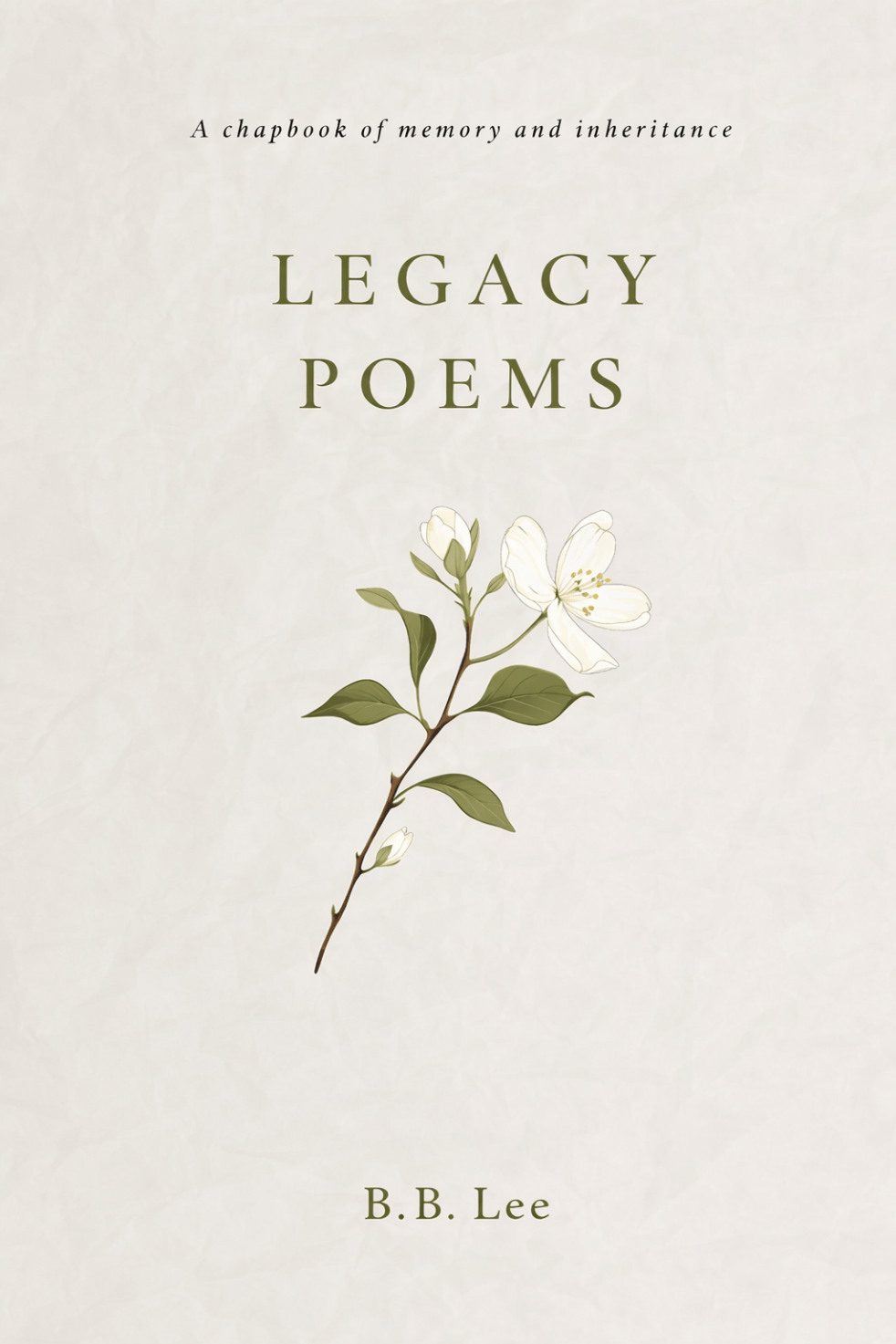
This month’s Book Club post is a little different. Instead of reflecting on a book I’ve read, I’m sharing a book I’ve written.

My latest chapbook, Legacy: A Collection of Poems, grew out of a long, quiet process of learning, unlearning, and sitting with uncomfortable truths. It reflects my discovery of the African American experience after immigrating to the United States as a preteen in the early 1990s—and how learning about the transatlantic slave trade reshaped the way I see history, identity, and my place in the world today.

If you’d like to read Legacy, it’s available here:
👉 https://www.amazon.com/dp/B0GM7KDDDV


Coming to the U.S. and Learning What I Didn’t Know

When I arrived in the United States, I came with my own sense of self, culture, and history. Like many immigrants, I was focused on adapting—learning how to belong, how to succeed, how to survive in a new place. What I didn’t yet understand was how deeply history lived beneath everyday life here.

It wasn’t until later—through school, conversations, reading, and lived experience—that I began to truly grasp the scope and brutality of the slave trade and its lasting impact on African Americans. That knowledge didn’t arrive all at once. It unfolded slowly, and with it came grief, anger, confusion, and a profound shift in my worldview.

Legacy was born from that reckoning.


What Legacy Holds

This chapbook is not an attempt to speak for anyone. It is a record of how learning this history changed me—how it complicated my understanding of freedom, resilience, inheritance, and responsibility.

The poems explore:

  • the weight of historical truth
  • the distance and connection between African and African American experiences
  • what it means to arrive somewhere without fully knowing its past
  • how knowledge reshapes identity
  • and how history continues to echo through the present

Writing these poems required me to slow down and listen—to history, to voices that came before me, and to my own evolving understanding.


Why This Book Matters to Me Now

Legacy represents a turning point in my writing. It’s where reflection met accountability. Where curiosity met responsibility. Where I stopped looking away from discomfort and allowed it to inform how I move through the world.

This book is about inheritance—not just of trauma, but of truth. And about what we do once we know better.


A Quiet Invitation

I’m sharing Legacy here because this Book Club space has always been about reflection and growth. If you choose to read it, I hope it invites you to pause, to consider history more closely, and to reflect on how knowledge shapes compassion.

Some books entertain.
Some educate.
And some simply ask us to sit with what we’ve learned.

Legacy is that kind of book for me.

Recipes

Sierra Leonean Stewed Black-Eyed Peas | Plant-Based Comfort by Lulu Lee

🌿 Remembering My Grandmother Through Food

Every time I make this stew, it feels like coming home. The smell of onions, bell peppers, and garlic fills my kitchen the same way it filled my grandmother’s when I was growing up in Sierra Leone.

Her black-eyed pea stew was always made with love — sometimes made with chicken, beef, or fish — depending on what was available that day. What made it special wasn’t just the ingredients, but the patience and care she poured into every simmering pot.

Now, years later, I’ve given up meat but not the memory. This plant-based version keeps her spirit alive in my kitchen, using soy strips instead of meat. The flavors remain rich, earthy, and comforting — a bridge between who I was and who I’m becoming.


🥣 Ingredients

  • 2 cups precooked black-eyed peas
  • 1 cup rehydrated soy strips (I use Mkostlich Soy Strips)
  • 2 large onions, peeled and chopped
  • 2 bell peppers, seeded and chopped
  • 1 large tomato, chopped
  • 2 tablespoons tomato paste
  • ½ cup olive oil (or palm oil, for a traditional flavor)
  • Seasoning salt, to taste
  • Cayenne pepper, to taste
  • Ginger and garlic, to taste

🍲 Directions

  1. Prepare the soy strips.
    Rehydrate 1 cup of soy strips in warm water or broth for 15–20 minutes. Once softened, squeeze out the excess liquid and set aside.
  2. Blend the vegetables.
    In a food processor, combine the onions, bell peppers, tomato, ginger, and garlic. Pulse until finely chopped (not fully pureed). This creates a smooth base that will thicken and flavor the stew.
  3. Sauté the base.
    Heat ½ cup of olive oil in a heavy-bottomed pot or Dutch oven (I use this Overmont enameled Dutch oven) over medium heat. Add the blended vegetable mixture and cook, stirring occasionally, until most of the liquid evaporates and the mixture deepens in color — about 10–12 minutes.
  4. Add the tomato paste.
    Stir in the tomato paste and cook for another 3–5 minutes to deepen the flavor.
  5. Add the soy strips.
    Toss in the rehydrated soy strips, stirring well to coat them in the tomato mixture. Season generously with seasoning salt, cayenne, and any additional spices to your taste.
  6. Add the black-eyed peas and simmer.
    Gently fold in the precooked black-eyed peas. Lower the heat to a gentle simmer and cook uncovered for 30–45 minutes, stirring occasionally. This slow simmer allows the flavors to blend beautifully and gives the soy strips time to absorb the richness of the sauce.
  7. Taste and adjust.
    Taste and adjust seasoning as needed. If you prefer a thinner consistency, add a small splash of water or vegetable broth near the end.

Serve warm with rice, boiled plantains, or bread — something that lets you scoop up every drop of that flavorful sauce.


💛 Reflections

Cooking this stew in my Dutch oven has become a small ritual of comfort. Its weight and warmth remind me of my grandmother’s patience — how she always said good food needs time, love, and the right pot.

Each simmer feels like a conversation with her, even though she’s no longer here. This dish connects me to where I come from, while also embracing how I’ve grown. It’s proof that you can honor your roots and still evolve in your own direction.


💭 Reflection Prompt for Readers

Is there a meal from your childhood that brings you comfort or connects you to someone you love?
How have you kept that recipe — or its memory — alive in your own kitchen?

Share your reflections in the comments — I’d love to hear the stories that feed your soul. 🌿

Recipes

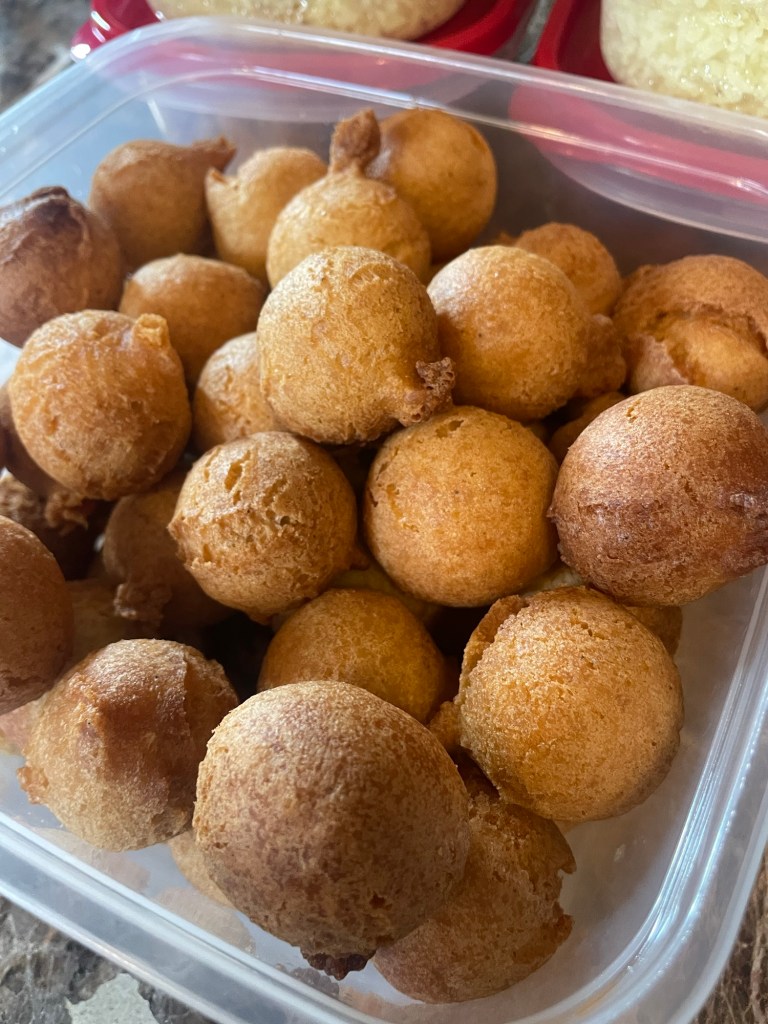
🍩 African Cake Donuts

There’s something magical about donuts—the smell of warm oil, the golden crust, and that first sweet bite. But these African cake donuts are more than just a treat. They offer a little taste of tradition with a modern twist.

These donuts are made with creamy coconut milk. They have a touch of ginger and a hint of cardamom. They are light, flavorful, and irresistibly good. They’re easy to make, don’t require yeast, and will fill your kitchen with the most comforting aroma.

🥥 Ingredients

  • 2 cups all-purpose flour
  • ½ cup sugar
  • 2 tsp baking powder
  • ½ tsp salt
  • ½ tsp ground nutmeg
  • ½ tsp ground ginger
  • ¼ tsp ground cardamom
  • 2 large eggs
  • ½ cup coconut milk (canned, well-shaken)
  • 2 tbsp melted butter (or neutral oil)
  • Oil for frying

👩🏾‍🍳 Instructions

  1. In a large bowl, whisk together the flour, sugar, baking powder, salt, nutmeg, ginger, and cardamom.
  2. In a separate bowl, beat the eggs, coconut milk, and melted butter until smooth.
  3. Combine wet and dry ingredients. Mix gently until a thick batter/dough forms. (Do not overmix.)
  4. Heat oil in a deep pan over medium heat.
  5. Drop small scoops of dough into the hot oil, frying in batches.
  6. Cook until golden brown on all sides, turning as needed.
  7. Drain on paper towels and serve warm.

📝 Recipe Card (Printable)

African Cake Donuts with Coconut Milk, Ginger & Cardamom
Ingredients:
- 2 cups all-purpose flour
- ½ cup sugar
- 2 tsp baking powder
- ½ tsp salt
- ½ tsp nutmeg
- ½ tsp ginger
- ¼ tsp cardamom
- 2 large eggs
- ½ cup coconut milk
- 2 tbsp melted butter
- Oil for frying
Instructions:
1. Mix dry ingredients.
2. Mix wet ingredients.
3. Combine to form dough.
4. Fry in hot oil until golden brown.
5. Drain and serve warm.


🌟 Why This Recipe Works

Coconut milk makes the donuts soft and slightly rich.
Ginger adds warmth and a gentle spice.
Cardamom gives a subtle floral note that pairs beautifully with the sweetness.


💡 Tips for Success

  • Keep oil temperature steady (around 350°F / 175°C).
  • Fry in small batches for even cooking.
  • Dust with powdered sugar or drizzle with honey for extra flavor.


✨ Final Thoughts

These African cake donuts are easy enough for a weekday snack. They are special enough to share at family gatherings. They’re warm, sweet, and full of comforting flavors.